The Delftse Hout used to be agricultural land, interspersed with marshes. The meadow-peat soils only permitted extensive livestock farming. Here you can read a bit about the history of the Delftse Hout. In the late 1960s, the Grote Plas was formed by sand mining. This sand was used for the construction of new residential neighbourhoods and their associated streets. The Municipality of Delft then developed a plan to transform the area into a recreation area, the Delftse Hout. The entire area now measures approximately 300 hectares, of which about 40 hectares of water. The Grote Plas itself is approximately 21 hectares. The area now borders the Bieslandse Bos, and you can walk and cycle through the greenery all the way to Zoetermeer.
The Grote Plas is now an average of 2.5 m deep. However, during the sand extraction, suction pits up to 7 m deep were created. Many of these deep pits have gradually disappeared as sand from the surroundings entered these pits. However, a number of deep pits remain, now 4 to 4.5 m deep. In 1966, Wageningen University conducted an initial study to determine whether the lake was suitable for swimming. Measurements between 1972 and 1974 showed that the chemical and bacteriological quality was adequate. However, the transparency was very limited, less than 1 meter. At the time, this was only a concern for physical swimming safety – it was assumed that people would drown more easily in turbid water!
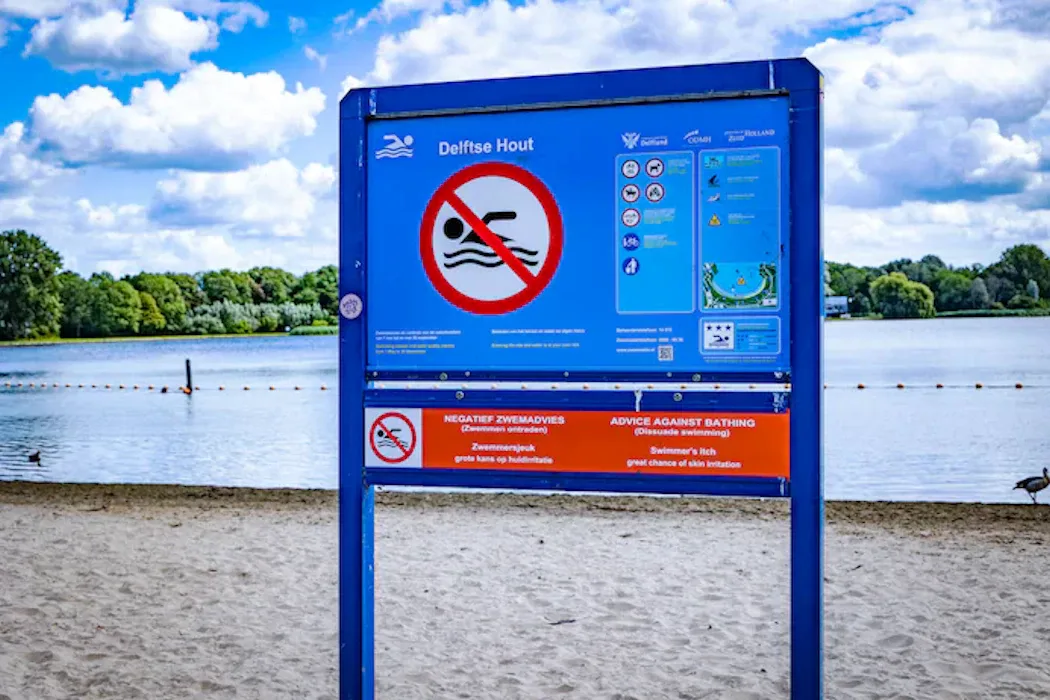
Furthermore, no consideration was given to the potential for eutrophication in the lake. Eutrophication refers to over-fertilization by nutrients, particularly phosphorus and nitrogen compounds. Blue-green algae are toxic cyanobacteria and thrive in this situation, especially as water temperatures rise, i.e. in the latter half of summer. Swimming is discouraged during this period because it can cause skin irritation (swimmer’s itch), gastrointestinal problems, eye problems, and so on. This has been a recurring problem in the Grote Plas (and also in the Dobbeplas) for years.
Some of these nutrients are dissolved in the water. But the majority adheres to the muds in the pond. This mud consists primarily of organic material, such as detritus (dead algae), blown-in leaves, and other plant debris. Therefore, in 2012, the Municipality of Delft and the Delfland Water Board decided to remove the mud by dredging and take other measures, such as demarcating a secluded dog beach, diverting drainage water, addressing goose nuisance, and so on. They also decided to combat the blue-green algae with hydrogen peroxide. This experiment continued for four years, and in 2017, no blue-green algae was found that summer. In the other years, the peak of blue-green algae was delayed by about five weeks.
The hydrogen peroxide approach, however, was merely symptom treatment, and the problem unfortunately quickly returned. Besides the overfertilization, there was/is another problem. Large parts of De Grote Plas are so deep that light can never reach its bed. Consequently, vegetation cannot grow. To understand the relationship with blue-green algae, we delve a little into the ecological cycle of a pond. Blue-green algae will also develop in a healthy, shallow pond. However, these are grazed (eaten) by water fleas. Water fleas, in turn, are food for a large number of fish. And in turn, these flea-eating fish are hunted by predatory fish such as bass and pike. Many of these fish (carp!) also rummage the bottom in search of food. In this way, the predatory fish essentially keep the cyanobacteria under control and maintain good visibility. But this only works if the predatory fish can see their prey—they are visual hunters. And that clear water is maintained by vegetation that arrests the muds.
Well, in spring, the Grote Plas is very clear, with meters of visibility. Plants develop rapidly in the shallower parts of the pond, including underwater plants. The water is teeming with water fleas. So why does it go wrong later in the year?
The key word is eutrophication. This is a problem in virtually all Dutch surface waters. When there are too many fertilizers, the blue-green algae grow so quickly that the water fleas can no longer keep them in check. And that growth accelerates as the water temperature rises, so later in the summer. The algae themselves also make the water slightly turbid. As a result, predatory fish can no longer see the flea-eating fish properly, so they cannot hunt them. Then there are even fewer fleas to eat the blue-green algae. The water becomes even more turbid, and light no longer reaches the bottom, causing the plants to die. And then it gets even more turbid, and then the carp come, stir up the lake bed, thus adding to the problem. They bring the fertilizers attached to the silt back into the water. And so on, and so on. It then proves very difficult to break that vicious circle and to restore the original situation – this is called hysteresis: returning a system to its original environmental conditions does not necessarily restore it to its previous state. In ecology, this is called a regime shift (tipping point). Well, scientists are very concerned that the climate also has such tipping points, and that it will therefore be very difficult to restore the pre-industrial situation.
However, initially large parts of the Grote Plas were already too deep for large-scale vegetation and the Grote Plas has been turbid from the start and has never seen that balance between blue-green algae – water flea – flea-eating fish and predatory fish, at least not throughout the year and not on the scale of the entire pool.
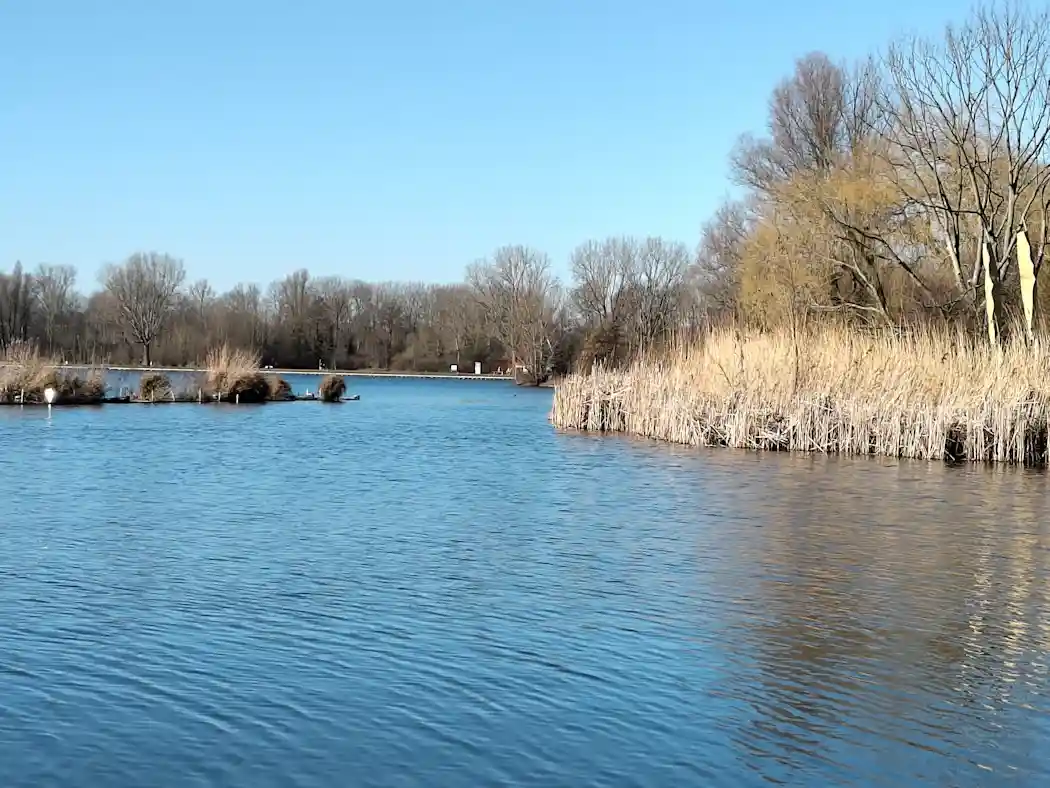
Reed banks (nature-friendly banks) and floating island in the Grote Plas.
That is why, for several years now, a different approach has been adopted to combat blue-green algae. Steep banks are being made less steep, allowing much more vegetation to grow along the banks (so-called nature-friendly banks – more shallow areas are created). This vegetation traps silt and also filters nutrients from the water. Floating islands with vegetation have also been created. This vegetation also filters nutrients from the water, and the water beneath the islands becomes clearer because there are smaller local currents and waves that could otherwise stir up the lake’s bed. Flea-eating fish are being hunted again. Furthermore, the mussels that naturally occur in the pond have been given a helping hand. This is done by creating a substrate, such as placing ropes under the floating islands. And because a single mussel can filter up to 10 liters of water per hour, this can significantly contribute to solving the problem.
However, such an ecological approach requires maintenance and time, and the blue-green algae problems are therefore not yet solved. This video tells the story of the ecological approach. Many visitors ask why we do no “just flush” the Grote Plas with clean water. Well, in “the water management of the polders” you see how low the Plas lies in relation to its environment. Flushing would be very difficult.