
“Staal” is the Dutch word for steel. Building on steel, however, has nothing to do with steel itself. When building on steel, the walls of a building rest on a wide base. This distributes the building’s weight over a larger area, preventing its sinking into the soil. The width of this base is determined by the local load-bearing capacity (“strength”) of the soil and, of course, the size of the building.
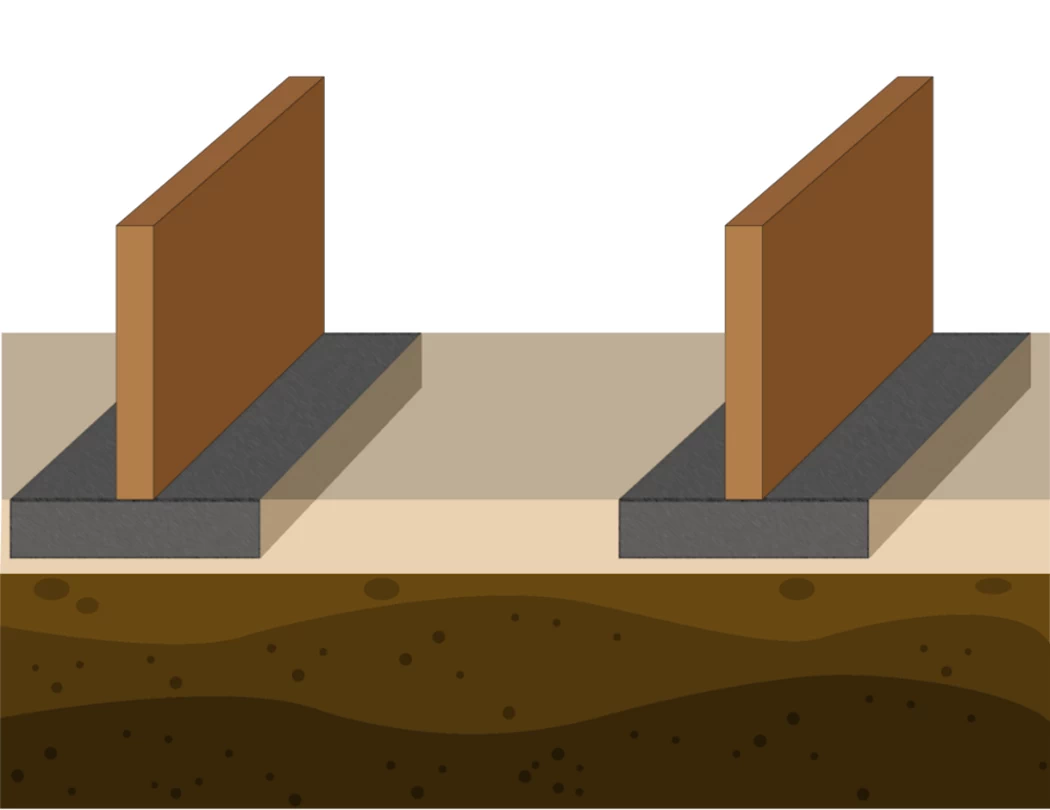
The term “staal foundation” originates from the Old Germanic word “stal” and the Old French “estal”, which means stand, a fixed place to stand or to rest on. Thus, “Staal” actually means a stiff/strong “base to build on”. In the past, the ground was excavated down to the required foundation level. Then an expert would advise whether the soil was strong enough to support the building, and about the width of the “staal”. To do this, they would take a soil sample — still known as a “sample” if you’re buying curtains, for example (in Dutch “staal” means steel, but also sample).
The entire historic city center, including the old eastern expansions (Rietveld, etc.), is built on staal. Because the ground there is much softer than on the creek ridge, large buildings (churches) could not be built there, and the foundation feet for regular housing had to be wider.
However, staal foundations are prone to subsidence. If this subsidence is not uniform, cracks can develop in the walls of the buildings. This is one of the reasons that Municipality and Water Board measure deformations of soil and buildings so frequent and accurate during the reducing of groundwater extraction by DSM. In the past, this staal foundation was made of brick. However, the quality of these old bricks was not very high in those days, and they were very porous. Therefore, many old houses in Delft suffer from rising damp along the walls.
On the other hand, the foundations of Delft’s city center are not affected by the groundwater level. Foundations with wooden piles, such as those in Gouda, Dordrecht, and Amsterdam, are sensitive to the groundwater level: if the piles are frequently or prolongedly exposed above the local groundwater level, the wood starts rotting and their load-bearing capacity decreases.
Source featured image: joostdevree.nl