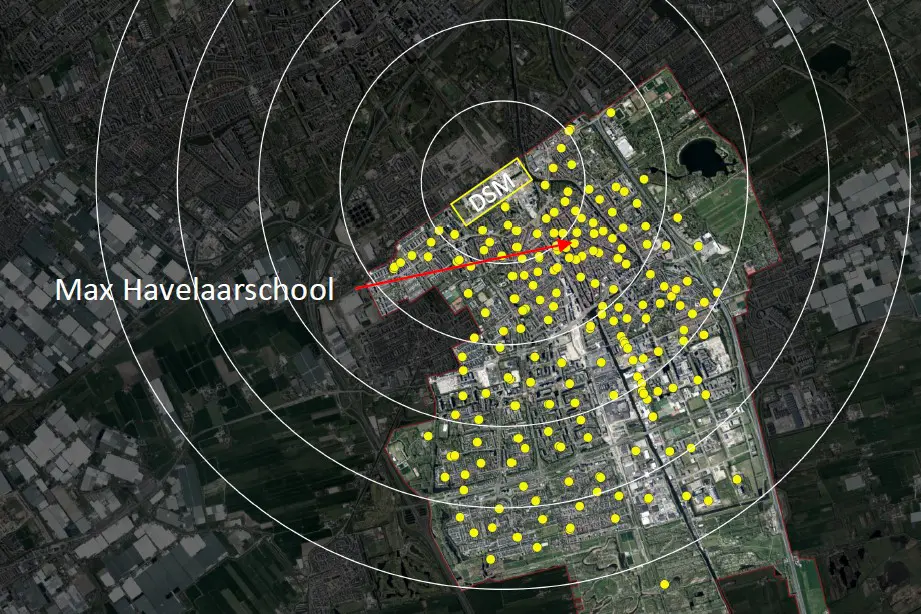
In 1906, the then Yeast and Spirits Factory began pumping groundwater from the Pleistocene sand layer. This layer is 20 to 40 m below ground level. It was used as cooling water in the factory. Initially, very little water was pumped, but over time this increased. From the 1970s, DSM, the successor to the Yeast and Spirits Factory, even extracted 1200 to 1600 m3/hour. If you extract that much water, a large negative pressure is created at and around the extraction point, a suction force (suction pressure). At the DSM, this even amounted to around 10 m water under pressure. That is so much that the effect could be measured up to 15 km further away, for example in Kijkduin.
Why is that groundwater extracted at such large depth? Well, the top 20 m of the soil consists of clay and peat. That soil has a low permeability. So you can extract very little water from one point, because the groundwater flows very slowly to the extraction point. In the sand layer that goes much faster.
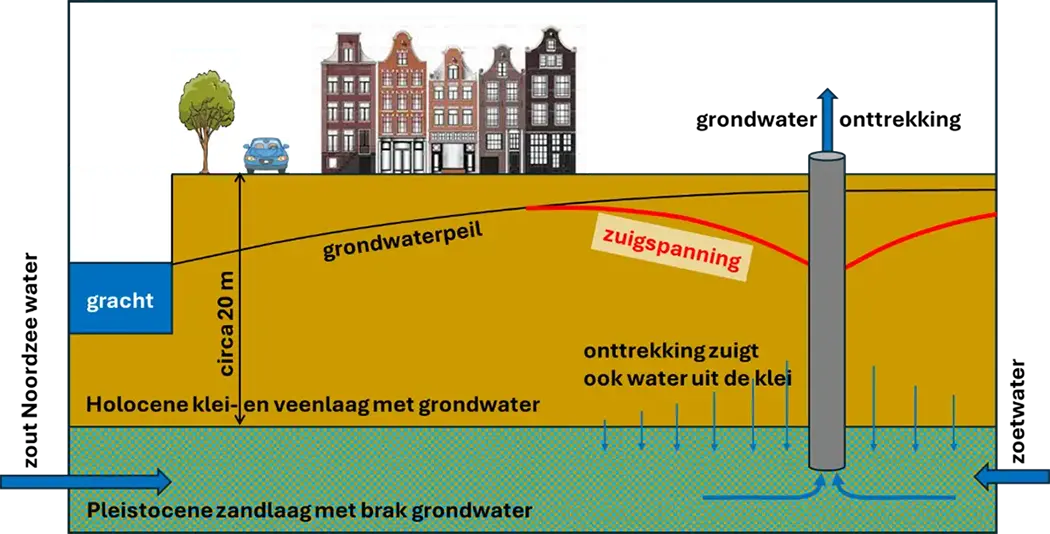
Groundwater flows and groundwater level as a result of groundwater extraction by DSM (drawing not to scale; dotted line indicates groundwater level without extraction).
That sand layer was deposited a very long time ago by the river Gantel in a period that geologists call the Pleistocene. That river was connected to the Meuse. These rivers brought a lot of sand to Delft and the surrounding area. Around the beginning of the Common Era, the coast broke through near Monster and a large part of what is now the Westland was flooded. Then thick layers of clay were deposited, and later peat was formed in a period that geologists call the Holocene. That is why the Westland is so fertile, and why people started to practice horticulture there.
The Gantel is still connected to the North Sea, but via a different sand package. That package was deposited long ago by the Rhine, which then flowed into the North Sea much further north, around The Hague. Most of the groundwater that DSM extracted from the sand layer is therefore supplemented with salt water from the North Sea. The groundwater in Delft is therefore brackish.
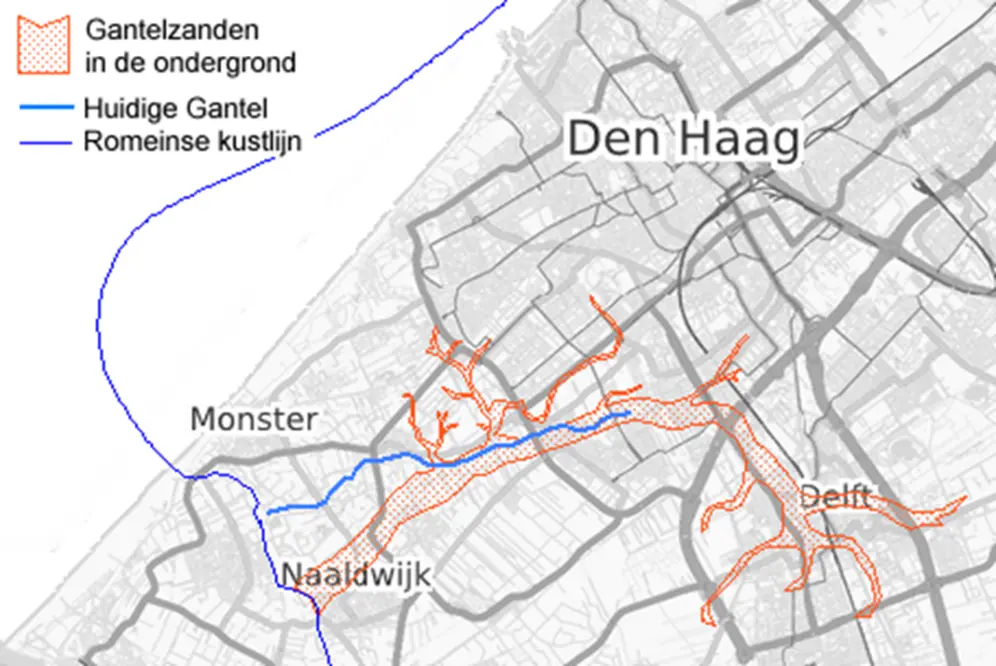
The Gantel and the sand deposited by the Gantel.
However, freshwater also flows from the interior to that sand layer to supplement the extraction, but that is not much. Finally, the large under pressure even sucks a little water from the poorly permeable clay layer to the extraction pipe. As a result, the high groundwater level (i.e. near the ground level) around the extraction drops. However, that is not much, in Delft about 0.2 mm per day, much less than the average precipitation in Delft. The measurements do indeed show that the shallow groundwater level has been more or less constant for years. It does fluctuate a little, but that is due to variations in precipitation. There is no trend in the shallow groundwater level visible with the increase or decrease in groundwater extraction over the many years of monitoring.
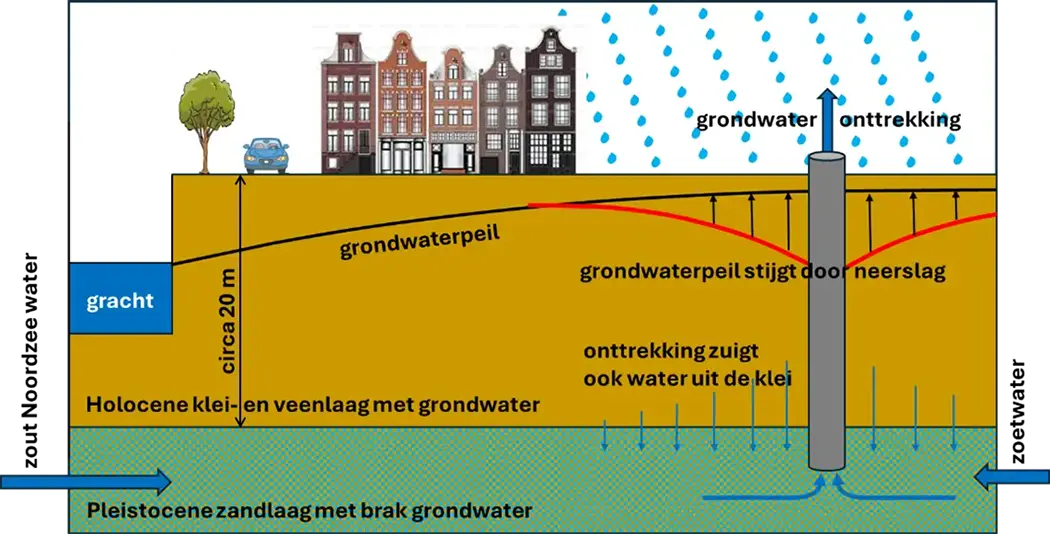
The precipitation more than compensates for the lowering of the groundwater level due to extraction (drawing not to scale; dotted line indicates groundwater level due to extraction).
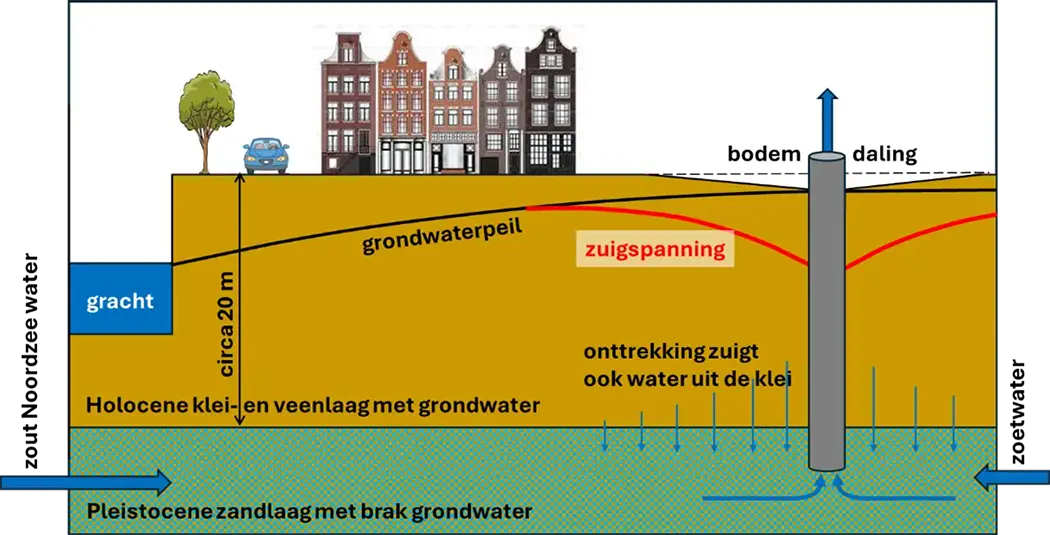
Soil subsidence due to groundwater extraction (drawing not to scale; dotted line indicates groundwater level without extraction).
However, the local under pressure sucks water from the lower layers of the Holocene clay/peat soil, from in between the pores and the from the clay flocs. Therefore, the soil land compacts, the land subsides. For example, the Rietveld sank by about 60 cm in just over 60 years. Experts think that half of this subsidence was due to the groundwater extraction.

DSM was not allowed to discharge the groundwater used for cooling water directly onto the surface water, because it was too salty. It also turned out that the iron content was quite high. That would have serious consequences for the water quality in the Rijn-Schiekanaal and the surrounding waters. DSM therefore had to discharge that water directly into the North Sea. This was done via a 15 km long pressure pipeline from Delft to Scheveningen. That was very expensive. DSM therefore started using cooling towers and the type of work in the company also changed. As a result, cooling water was no longer needed. That is why DSM announced around the turn of the century that it wanted to stop extracting groundwater. Would the situation of 1906 then be restored?
That had to be investigated. After all, due to the years of extraction, a balance has developed in the soil between the groundwater pressure, the groundwater flow and the stresses in the soil itself (experts call the latter the effective stresses). If you stop extracting from one day to the next, spatial differences (gradients) can arise in those stresses and the soil can deform. The research showed that if you reduce the extraction slowly, not many problems are expected to arise. The studies suggested a safe method reducing the extraction by 10% per year. This strategy has been implemented by the Municipality of Delft since 2017, and this animation shows how that works. According to the planning, the extraction can be stopped completely in 2028.
The situation of 1906 is not restored, however, because the ground level became lower due to subsidence. The soil (the clay layer) does bounce back a bit when the underpressure disappears, but this is only a few millimeters: subsidence is virtually irreversible. The groundwater level then rises, relative to the ground level. We then have less space for water storage in the street.
But of course you want to know whether those research results are indeed correct; you do not want cracks in your houses. That is why the Municipality of Delft and the Delfland Water Board continuously measure the groundwater level at so many locations and at more than one million points, they measure monthly whether the soil is subsiding further, or rising, or whether buildings are deforming. This rising of the soil is called swelling and is a typical property of clayey soils. Incidentally, this swelling is very small, no larger than approximately 0.1 – 1 mm / year.
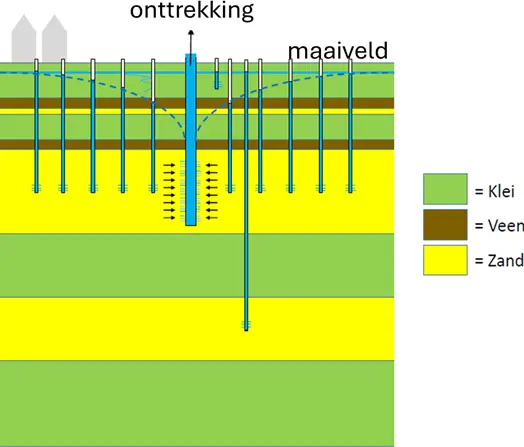
Shallow wells measure the shallow groundwater level in the Holocene clay / peat layer just below the gauge field (up to approximately 1 m depth) and the deep wells measure the (under)pressure in the 20 m deep Pleistocene sand layer.
Stopping groundwater extraction can cause groundwater hindrance by raising the groundwater level and by soil subsidence. The first can be reduced by installing drainage pipes in the street. The Municipality of Delft is doing this. These drainage pipes also control groundwater levels relative to that of the surface water. This also creates space for climate adaptation.