Old Delft Water Walk
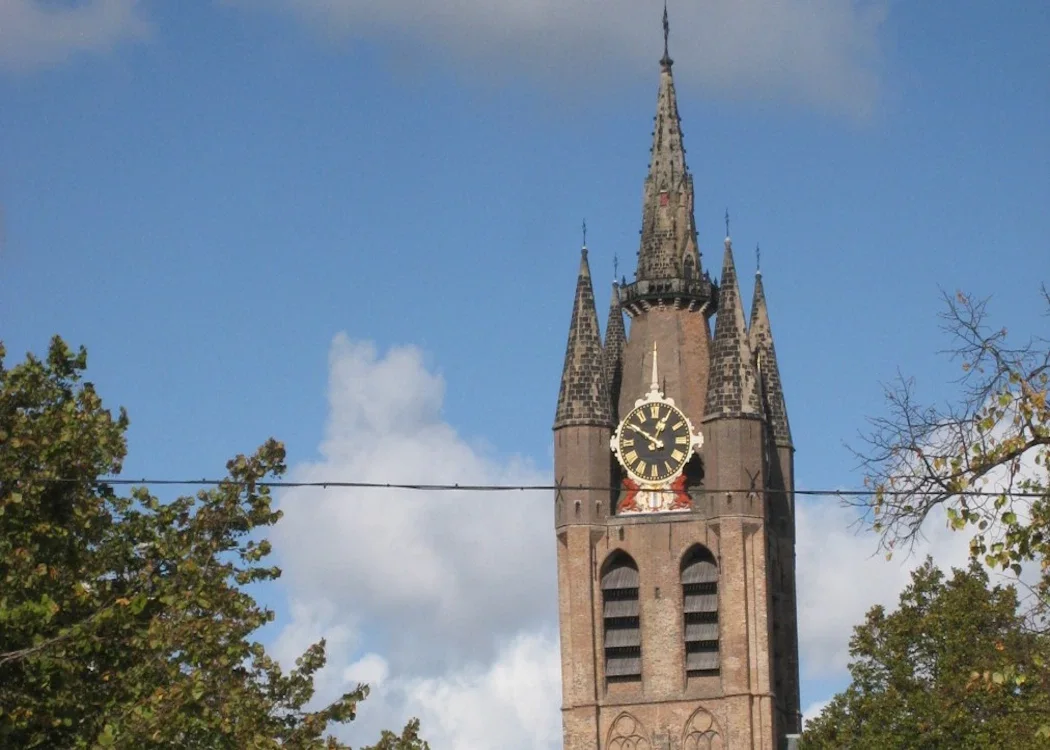
A bit further you see the Old Church with visitors entrance around the corner. The Oude Kerk (Old Church), known locally as Oude Jan (Old John), is said to date back to 1246. However, that was the year Delft received city rights from Count William II. Likely, as early as 1050, a small wooden church stood on this site. Over the years, it was expanded, renovated, and built of stone. This continued after 1246. For example, the now-leaning tower was not completed until 1350. Further information about the Oude Kerk can be found on its Wikipedia page.
In 1570, the Trinitas bell was placed in the tower. It is the largest bell in the Netherlands, weighs 9,000 kg with a diameter of 2.3 m. It is known locally as the Bourbon. When the bell is rung, it causes strong vibrations in the tower, potentially damaging its structure. Therefore, the bell is only rung at very special occasions, such as the burial of a member of the royal family in the Nieuwe Kerk (New Church). This is also why the vibrations in the tower are carefully being measured.
In the 19th century, the local authorities were afraid that the tower would collapse. Therefore, in 1843, the Delft City Council decided that it had to be demolished. Fortunately, local contractors managed to prevent this.
The church was built on the creek ridge. However, there was no more room for the tower. Therefore, the newly dug canal, “de Oude Delft” was narrowed locally, and the tower was partially built on the infill. However, this subsoil had much less bearing capacity than the sand of the creek ridge. Thus, the tower began to lean, already during its construction. The second part of the tower was then built straight up atop the leaning lower part. This is why you see a bend in the tower. The top of the tower now leans over by about 2 meter.
By the way, the tower (and the entire church) is ‘built on staal‘: the foundation consists of a wide brick base. It’s a myth that the tower is founded on cowhide. Incidentally, the entire old city center is built on staal. That is why Delft does not have the foundation problems such as in for instance Gouda, Dordrecht, and Amsterdam, which were built on wooden piles.
However, the bricks used at the time were not of very high quality. They were quite porous. That is why many old houses in Delft have problems with damp walls.