New Delft Water Walk
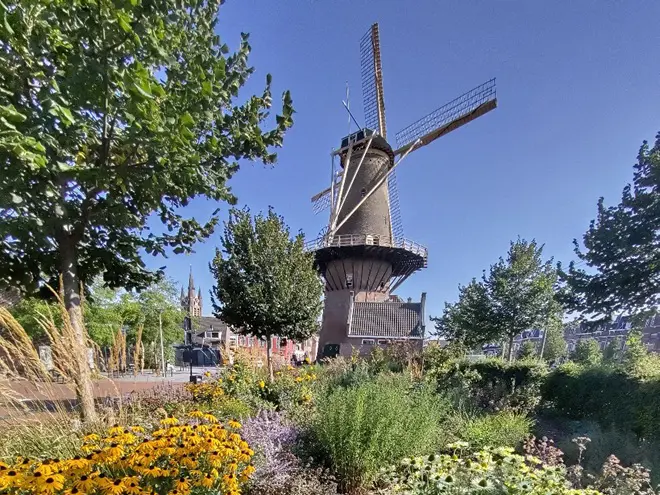
Windmill ‘The Rose’ (Molen de Roos) was built around 1760, at the location where windmills have stood since 1500. It was built specifically for grinding flour and is still in use today for that purpose. When the train tunnel was being built, the windmill was placed onto a large concrete slab and was raised by one meter so the roof of the tunnel could be constructed. After its construction, the windmill was returned to its original position. In 2019, a garden (the Molentuin) was established next to the mill. It has a large variety of plants, selected to bloom in all seasons and to be climate resistant. Both the windmill and the garden are run and maintained by volunteers.
Windmill The Rose is the only one of the 18 windmills in Delft that has survived over time. It was built on the spot where the Gasthuismolen was built in 1352. That was a so-called post mill, the oldest type of windmill in the Netherlands which could be turned into the direction of the local wind. In the following 300 years, the windmill was gradually rebuilt and raised to catch enough wind between the buildings of the growing city of Delft. Around 1760, the windmill was given its current shape and was baptized ‘The Rose’. The windmill has served as a grain mill ever since, and the flour is still ground with the original millstones. You can buy it in the small shop adjacent to the windmill, together with bread baked with that flower.
Around 1929, the windmill began to lean due to the construction of the tram line and roads, the filling in of the canal along the Phoenix Street, and the groundwater extraction by the local Yeast and Spirits Factory (now DSM-Firmenich). A decade-long restoration followed, during which the entire cap and the sail cross had to be renewed. A new foundation was constructed and the mill was jacked up on one side by more than half a meter so that it stood straight again. Finally, the windmill was put back into use in 1990 and the sails could turn again.
But that did not last long, because at the beginning of the 21th century the railway tunnel was built, its trajectory had to pass directly under the windmill. This was technically of excellence and how that was done, you can read here. Aart Struijk wrote a beautifully illustrated book about the history of the windmill. And in the Molen Database you can also find much more detailed information.
But the windmill itself also tells a story. It does so in mill language. Here you can see what the windmill tells you, whether there is a party, whether someone died, whether the miller is at work or on long vacation.
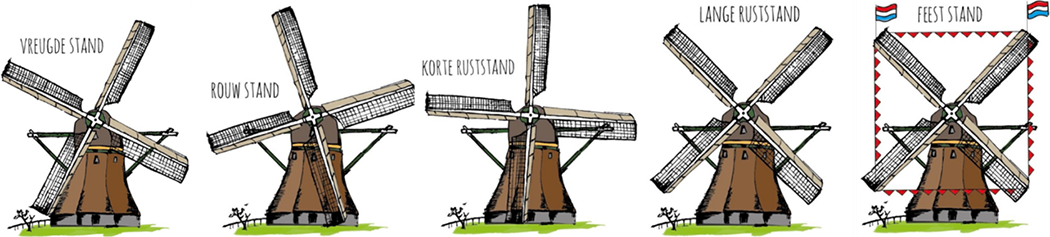
Mill language (from left to right): Happiness, Mourning, Brief rest, Long rest, Party-party
On the North of the windmill there is the Mill Garden (‘Molentuin’). This was created in 2019 by volunteers, who also maintain the garden. The garden has an enormous variety of plants. Every season something different blooms. And there are grain beds, where you can see how the grains grow which are ground in the windmill. Here you can read which plants and grains grow there.
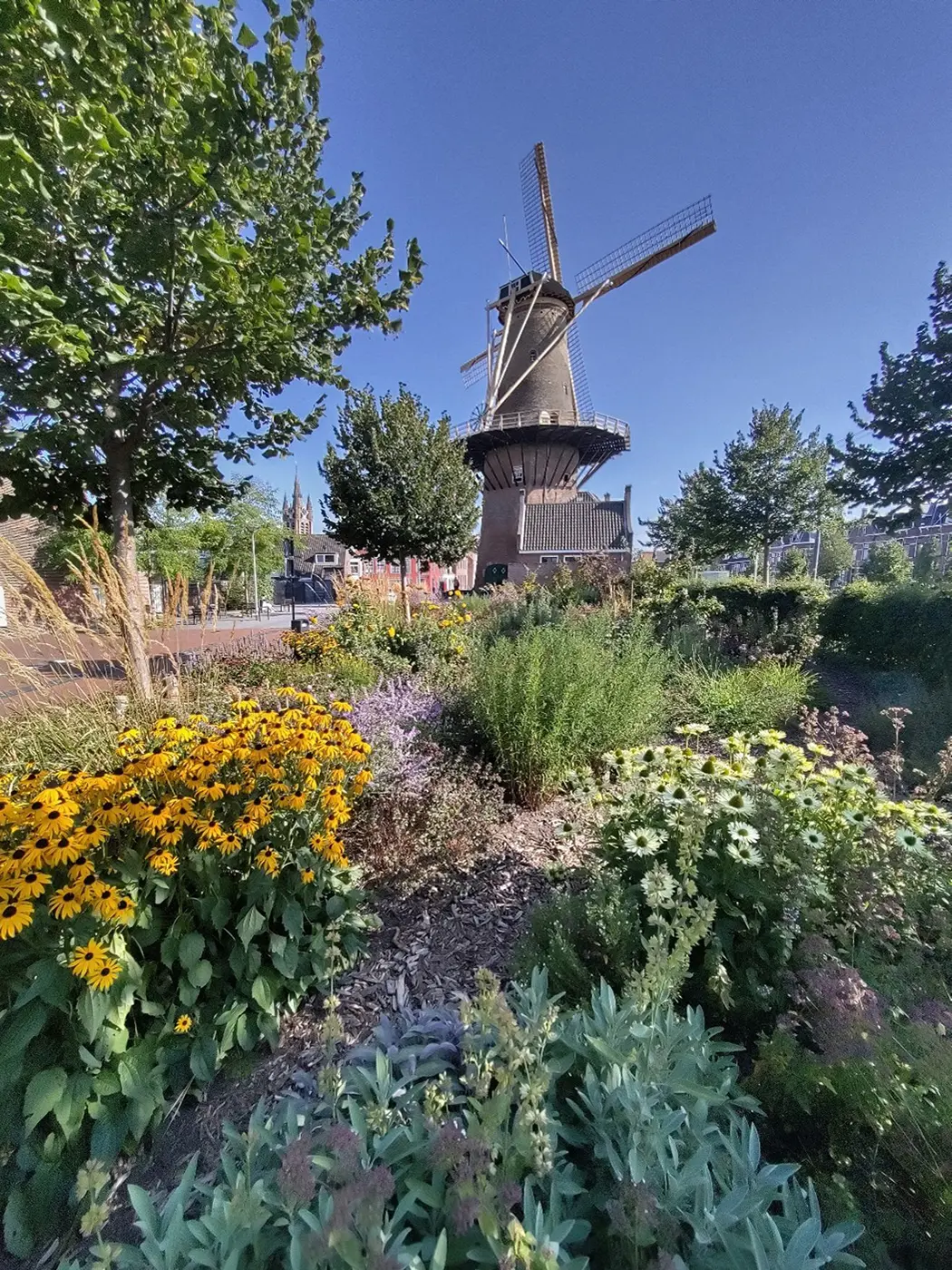
The Windmill Garden.