New Delft Water Walk
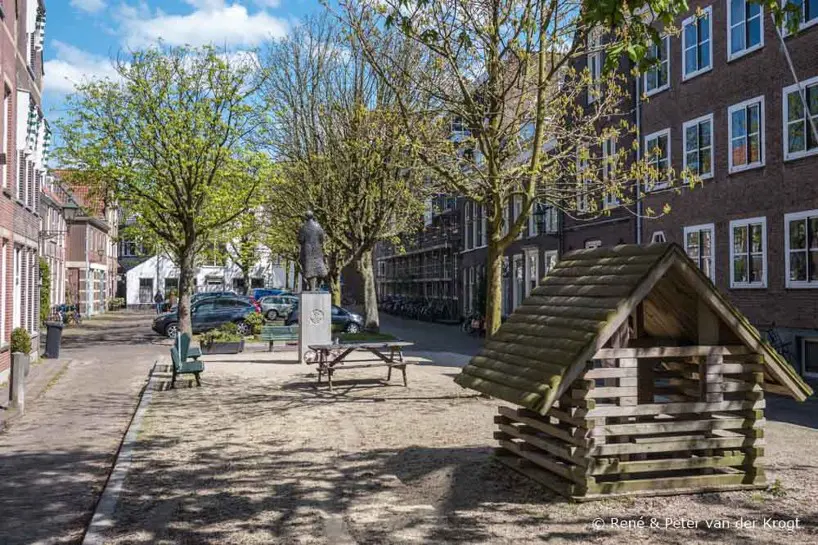
The Beguine Courtyard (‘Bagijnhof’) was founded in 1287. The Beguines were unmarried women who lived in religious communities and stressed imitation of Jesus’ life through voluntary poverty, care of the poor and sick, and religious devotion. Within the courtyard, two well-known buildings are the Maria and Ursula hidden church (‘schuilkerk’) and the old Bethel Hospital, which is now student housing. The courtyard was completely renovated in 2023, and the existing parking lot was replaced by a beautiful garden as well as an underground water storage system to help reduce local flooding during intense rainstorms. With this renovation, one of the oldest courtyards in Delft is now adapted for climate-change and is prepared for the 21st century.
The Bagijnhof was erected at the lowest point of the creek ridge upon which Delft was built – water therefore flows easily to the Bagijnhof. There was an urgent need to address the water management here, in particular when the water problems increased after the construction of the railway tunnel. After intensive consultation with the residents, it was decided to redesign the entire yard. The original parking places were replaced by open paving with plenty of greenery and a playground. Underground pipes were laid to collect rainwater from the courtyard and the adjacent properties, as indicated in the cut-out drawing. This water is stored in a reservoir of 140,000 liters. When the reservoir is full, excess water is slowly drained into the Oude Delft. The reservoir provides the vegetation with water for an extended period; the plants can thus survive two months of drought.

Around the 11th century, single women in large parts of Europe came together for economic, social, religious and political reasons and entered into a life of simplicity, poverty and chastity. They became known as Beguines. The women rebelled against, among other things, the prevailing Catholic practices, such as clergy publicly living with their mistresses. Nevertheless, the Pope eventually approved this movement in 1216 after which it grew rapidly. This was also the case in Delft, and in 1286 permission was granted to establish the Beguine Courtyard. However, it remained relatively small, with, for example, 60 Beguines in 1381. A famous Beguine from that time was Geertruida van Oosten, who stood out because of her very pious life. A statue next to the Oude Kerk (Old Church) still commemorates her life. Another famous resident of the Beguine Courtyard was the priest and poet Johannes Stalpaert van der Wiele. Ironically, he became famous for his writings protesting against the Reformation, a movement that also opposed Catholic church practices.
After the Delft city fire of 1536, the Beguine Courtyard was rebuilt and given its current form. The western entrance is opposite the Beguine Tower on the Phoenixstraat. On the eastern side, there is a gate leading to the Oude Delft. On that gate you can vaguely see an image of John the Evangelist. In the Courtyard, at house number 23 you will find the Maria and Ursula Church, an Old Catholic Church. This became a ‘hidden’ church in 1743, at the time when the Catholic faith was officially forbidden, but tolerated as long as it was conducted secretly.
In 1899, the Protestant Bethel hospital was opened, with entrances on the Oude Delft and the Beguine Courtyard.
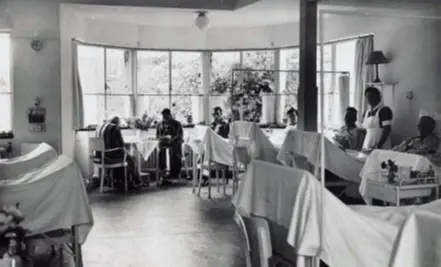
The children’s ward of the Bethel Hospital in 1960 (archive photo).
In the beginning of the 1970s, the Bethel Hospital was converted into student housing. The hospital’s nurses residence, almost next to the ‘hidden’ church (Oud-Katholieke Schuilkerk), is now a popular residential community where work and living are combined.