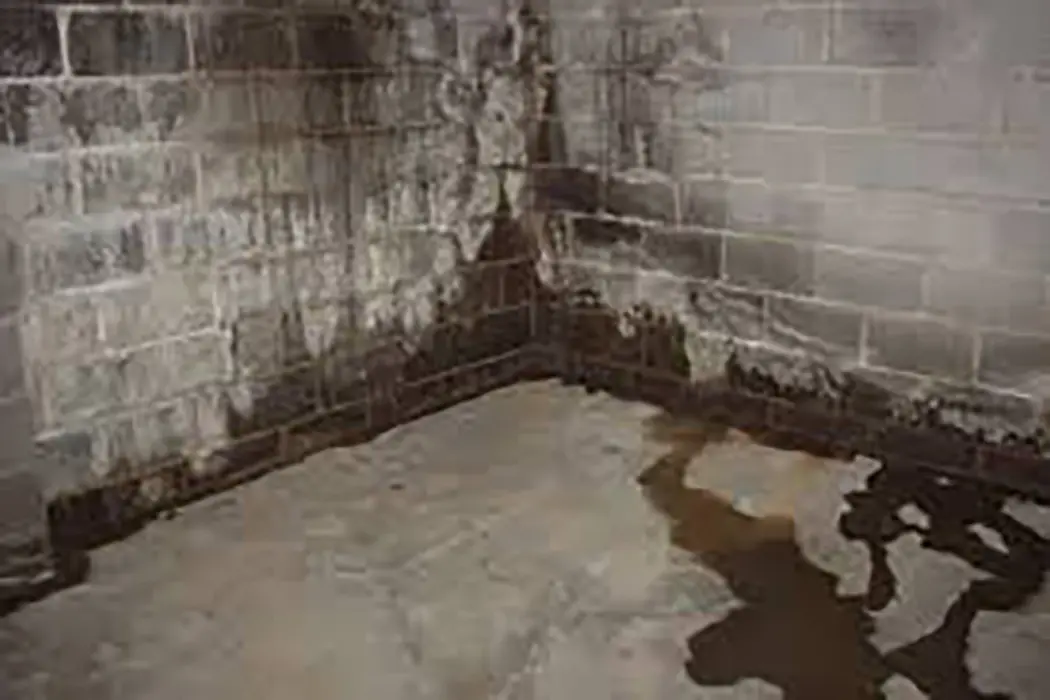
But what is groundwater actually? That is explained here, and also why the groundwater level is so high in some places. A high groundwater level can cause problems for houses and infrastructure, and complicates the storage of rainwater in the street. Residents must themselves solve any problems caused by high groundwater in their homes and gardens. But a high groundwater level can also cause problems in the street and in other public spaces. That is why the groundwater level is continuously monitored with 210 wells in the city. In addition, the Municipality of Delft has set up a counter where residents can report groundwater nuisance. All that information is mapped so that the municipality knows where to intervene. Every citizen can view that information.
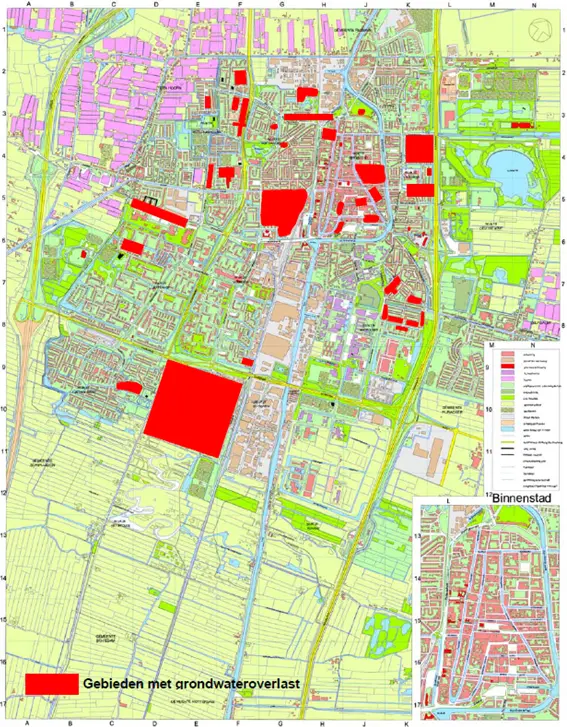
Map showing areas with groundwater nuisance, where infiltration of rainwater is therefore difficult (from: Groundwater Vision Municipality of Delft, 2005).
A proven method to lower the groundwater level and thus reduce groundwater nuisance is drainage. This is done with a kind of sewer system. Only now the pipes are porous, so that groundwater can flow into these drainage pipes. Of course you do not want the sewage pipes themselves to be porous, because then dirty water leaks into the ground. So one cannot combine these systems.
The porous drainage pipes are connected to the canals in Delft, or surface water elsewhere in the city. The level of that surface water is determined by the water level management of the Hoogheemraadshap van Delfland (Delfland Water Board). Here you can read how those drainage systems influence the groundwater level and reduce groundwater nuisance.
The construction of the railway tunnel also affects the groundwater movements. The deep walls that support the tunnel extend into the 20 meter deep Pleistocene sand layer, and as a result the west-east groundwater flows in the overlying Holocene clay/peat package are blocked. Here too, drainage offers a solution: a high groundwater level is compensated by runoff into the drainage pipes.
Read more about groundwater in Delft
Groundwater vision Municipality of Delft, 2005. Reg. no. 847857.