Many fish migrate in search of food, safe havens, and shelter, or for reasons related to water quality (temperature, oxygen levels, etc.). Some fish travel long distances to reach their spawning grounds. These are migratory fish. The best known are eels (elvers, glass eels) and salmon, which migrate between saltwater and freshwater.
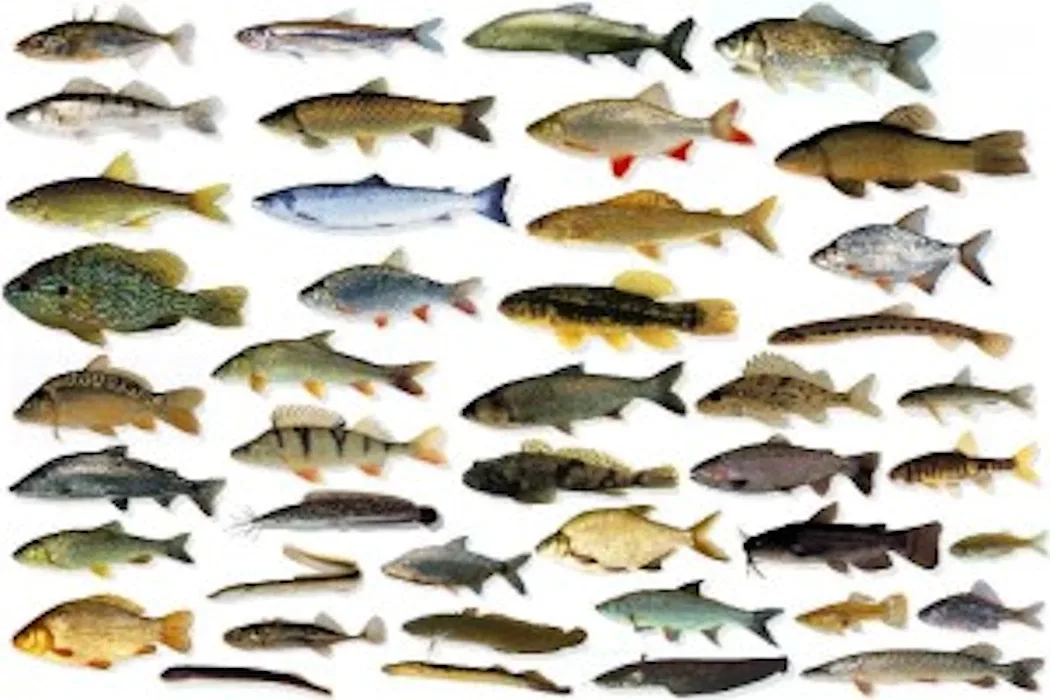
Fish in South Holland waters also migrate. The three-spined stickleback, for example, lives in saltwater and migrates to ditches and streams (thus into the polder) between February and May to breed. Between July and September, the youngsters migrate back to their saltwater habitat (thus out of the polder). Other fish, such as roach (common rudd, bitterling, common rudd), carp, perch, and zander, migrate within a polder, or in between polders in search of shelter, food, and suitable spawning grounds, but remain nearby. They never leave freshwater. Publications from the nature conservation organization RAVON (Reptiles, Amphibians, and Fish Research Netherlands) provide extensive information about these fish and their behaviour.
The Delftse Schie is a vital connection for fish in the Delfland Water Board’s water system. Fish such as eels and three-spined sticklebacks use this waterway as a route to swim from their birthplace to the sea and back again to reproduce.
However, this migration is hampered by the numerous structures in our polder waters. A moderately high spillway is an obstacle to overcome, but a pumping station is impassable – fish are grinded in the pumps. Consequently, fish stocks around Delft, and elsewhere in the country, steadily declined until measures were taken in the final decades of the last century.
The New Fish Atlas shows maps of fish found in the South Holland waters. These maps also demonstrate that the many measures to promote fish migration are starting to pay off. Fish, including rare ones, are repopulating their traditional habitats, and fish numbers are increasing. Here you can read about the contribution of the Delfland Water Board to this and what measures are available.
The fish passages in the pumping stations of the Polder van Nootdorp and the Polder van Biesland consist of a shaft with a waiting room, which can be closed, as shown here. In the spring, when the fish want to swim into the polder, polder water is pumped into the boezem using a small pump. In the autumn, when the fish want to leave the polder, reservoir water is pumped into the polder. The fish smell this water and are lured into the shaft – this is the so-called attracting current (lokstroom). They swim into the waiting room, and after a while, the doors close behind them, and a door opens to the other side of the passage. This allows the fish to overcome large height differences without passing the pumping station’s pumps.`
These cycles repeat several times a day and night during the migration season, according to a schedule devised by fish biologists. Here is another interesting YouTube video about fish passages as part of the series “Ernst’s Underwater World” by Ernst Raaphorst, ecologist at the Delfland Water Board.
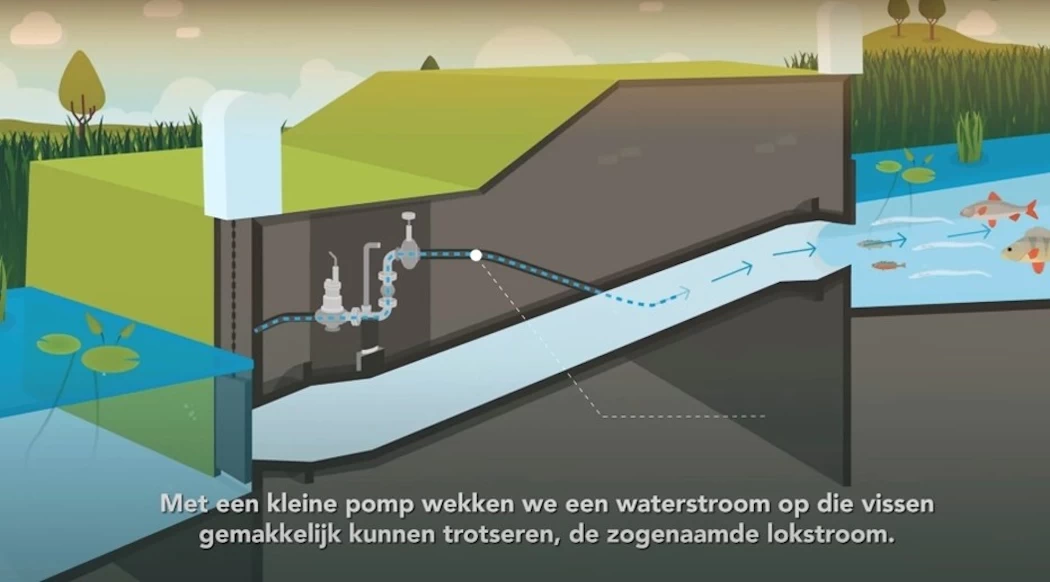
Schematic of fish migrating from Boezem to polder.