Old Delft Water Walk
Then, from the Kantoorgracht via the Paardenmarkt and the Raam to the Rietveld. As you walk onto the Paardenmarkt (“Horse Market”), you see two large, striking buildings. On the left is the former artillery magazine and, on the right, the former artillery barracks. Long ago, a monastery stood at the site of the magazine. It was expropriated in 1637 and converted into a gunpowder magazine. In 1654, all that gunpowder exploded, devastating a large part of Delft. The magazine was then moved to a location along the Schie River outside Delft. This is now known as “het Kruithuis”. The current magazine was built on the ruined site in 1671 and retained a military function until the mid-20th century. In 2015, the Buccaneer was located there, housing several start-ups in the energy and offshore industries, as well as a restaurant.
The artillery barracks were built in 1845, expanded in 1863, and remained in use until 1927. After several renovations, it now houses a few apartments, a healthcare facility and the “Jan en Alleman” day-care centre.
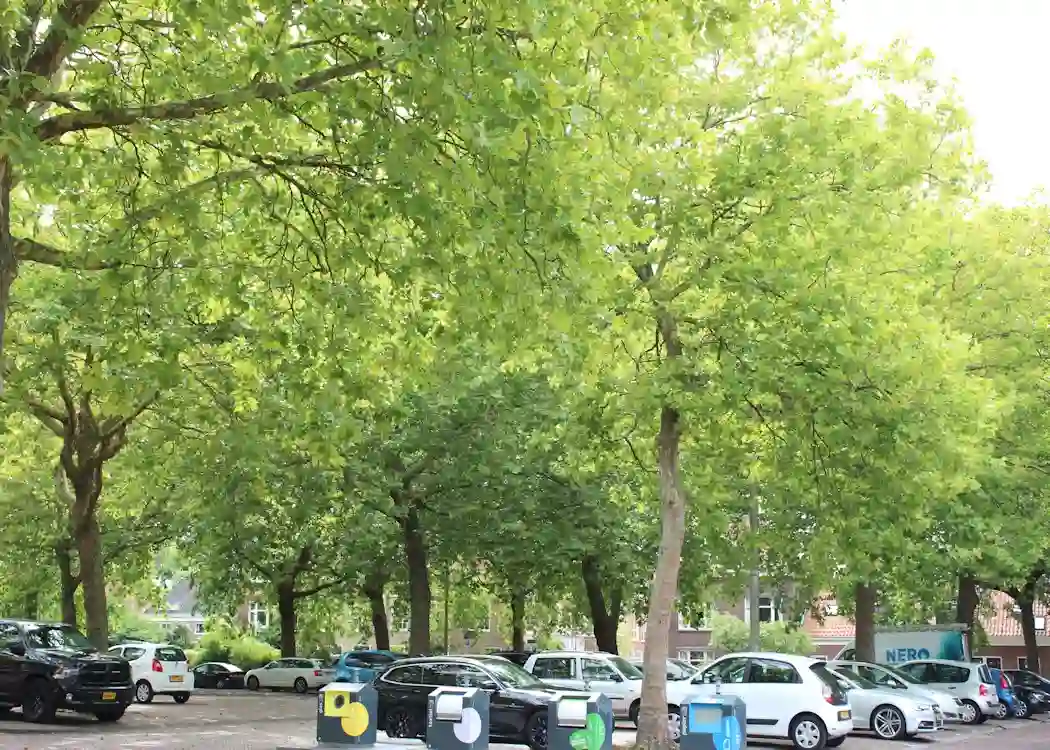
The explosion of the gunpowder created a large open space. Horses were permitted to be traded here from 1659 onward. Since then, the square has been known as the Paardenmarkt (Horse Market). You see many socalled plane trees here. On a warm day, you will notice the effect of trees on the city temperature. The many trees cool the Paardenmarkt by many degrees – compare it to the Markt (Market Square) (stop 12).
Why do trees provide so much cooling? This is because trees evaporate water through their leaves, and evaporation draws heat from the environment (known as evaporative heat). Depending on the type of tree, its size, and its age, a single tree can evaporate as much as 10 litres of water per hour, lowering local air temperatures by almost 2° C. Here you can read how that works.
At the Raam 63, you see a house in a completely different style than the other buildings in the neighbourhood. This house is now a municipal monument. It was formerly the official residence of the janitor of the Delft Hydraulics Laboratory. This laboratory was founded in 1927 and established at the Raam in 1933. When the site became too small, the institute moved in 1973 to the Rotterdamseweg. In 2008, the Delft Hydraulics Laboratory, or Delft Hydraulics as it was then called, was incorporated into the new institute Deltares. This is a large, internationally operating and internationally recognized Major Technological Institute (GTI) specializing in water, subsurface, and infrastructure. It plays a key role in the transition towards a climate-resilient Netherlands.

Delft Hydraulics Laboratory started here in 1927.
On our way to the Rietveld, we see many round manhole lids in the street. Some are labeled “rainwater,” “clean water,” or “drain,” while others say “sewage,” “wastewater,” or nothing at all. This depicts the dual sewage system here. The clean water sewer not only collects rainwater from the Paardenmarkt, but can also actively pump water from the Rietveld to the Kantoorgracht (Aquagate).

The dual sewage system drains dirty (vuil) and clean/rain (schoon) water.
The clean water sewer discharges its water onto surface waters. Therefore, you are no longer allowed to wash your car on the street. You are also not allowed to discharge oil residues, etc., into the sewer. This is stipulated in Delft’s General Local Bylaws.

In this manhole you find a pump that can pump water from the Rietveld to the Geerweg.