Old Delft Water Walk
We pass a small bridge, down de Bonte Ossteeg to the Market Square. On a summer day, you may notice how hot it can get here – this is heat-stress due to a lack of water and trees. The accompanying picture shows the large temperature differences between different soil types (by Louis de Jaeger).

The near-ground temperature for different ground cover on a hot summer day (after Louis de Jaeger).
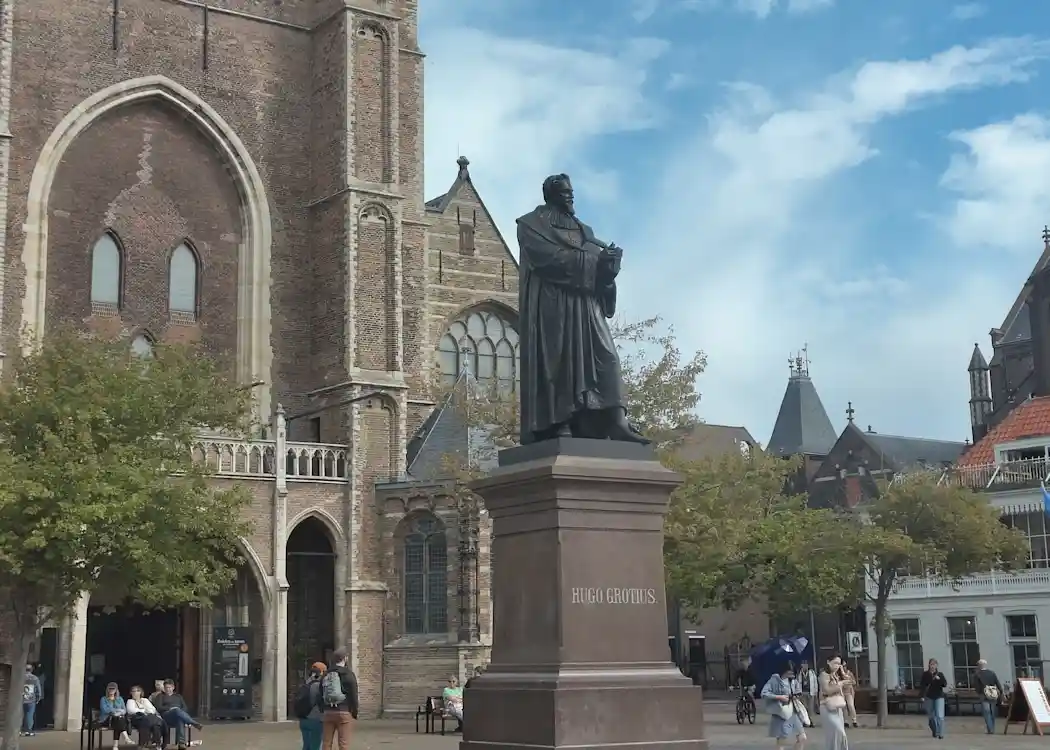
The Delft Market Square is, of course, famous for its Nieuwe Kerk (New Church) and the magnificent Town Hall, as well as several other monumental buildings. Here, however, we pause at the statue of Hugo de Groot (or Hugo Grotius).
Hugo Grotius was born in Delft in 1583. He was a classicist, writer, and poet, but he achieved his greatest fame as a legal scholar. He is still considered one of the greatest legal scholars of all time. He worked in The Hague and Rotterdam, in France, Sweden, and Germany, where he also died (Rostock 1645) – see, for example, the Wikipedia page on Hugo Grotius. Dozens of biographies have been published about him.
He wrote his Mare Liberum in 1609, which was not published until 1868. This work forms the basis for modern international maritime law. Hugo Grotius’ premise is that the oceans and seas belong to everyone and should be accessible to everyone for trade and travel.