Outer Delft Water Walk
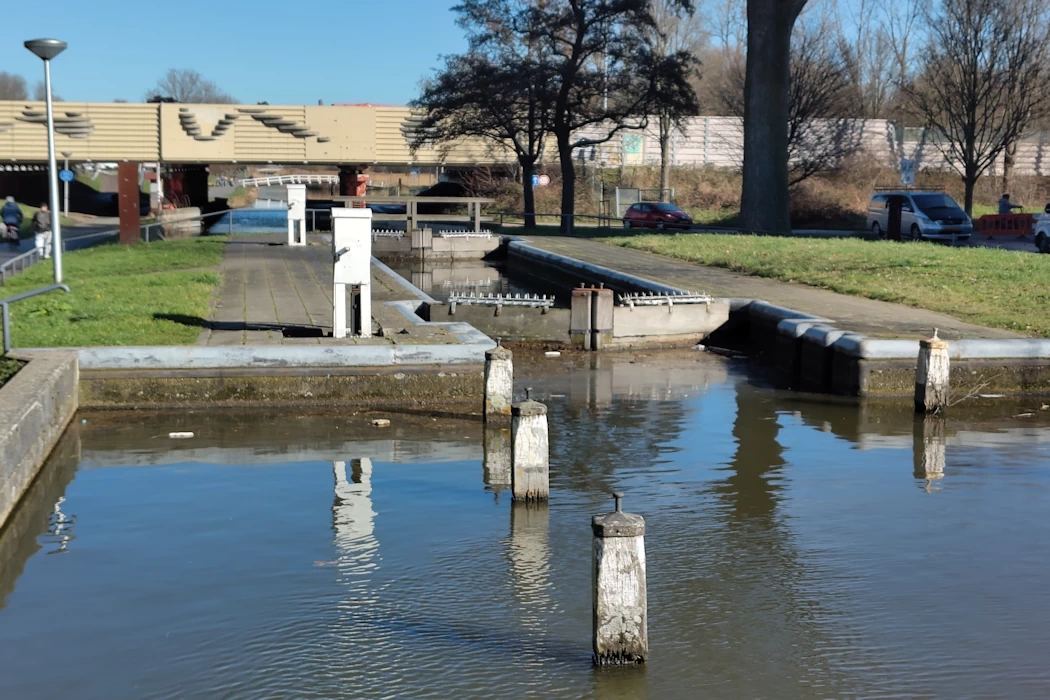
We walk west/southwest under the A13 motorway to the Tweemolentjesvaart sluice on Tweemolentjeskade / Aan ‘t Verlaat. A sluice is a structure in a waterway to regulate water levels. This sluice consists of two double doors, which can be opened and closed independently. The doors of this sluice are almost always closed.
The water level in the Tweemolentjeskade is the same as that in the Rhine-Schie Canal. This is the so-called reference level of the Delfland Water Board and is 43 centimeters below NAP (-0.43 m NAP) everywhere – this is called the water board’s Boezempeil (peil = level). When the water level is too high, excess water is discharged into the North Sea through sluices in Schiedam, Delfshaven, and Scheveningen, among other places. When the water level is too low, freshwater is taken in from the Brielse Meer, via a 4.2-kilometer pipeline passing under the Nieuwe Waterweg. This pipeline has a capacity up to 4 m³/s supplementing the reference water level.
NAP is the Dutch ordnance level, which is almost equal to the mean sea level at Scheveningen. The water levels in the polders are controlled by a cascade of pumping stations, sluices and weirs. The first reference level is the “Boezempeil” at -0,43 m NAP, which is maintained throughout the Water Board’s management area. Next in the cascade is the Binnenboezem (the inner reference level). There are many Binnenboezems; in our Outer Delft Water Walk we meet two, which have different reference levels. Next in this cascade are the levels in the polder ditches, which are controlled by a cascade of sluices – these vary largely, as we will see.
Thus, on the west side of the Tweemolentjeskade (the “high” side), the water level is -0.43 m NAP. On east side of the Tweemolentjesvaart (the “low” side), the water level is -2.3 m NAP in summer and -2.35 m NAP in winter. These are the so-called summer and winter levels of the “Binnenboezem” (Inner Boezem). This inner boezem is crucial for water management in the polders northeast of Delft. Here you can see an overview of these polders, and we explain what a polder is. This inner boezem, incidentally, serves the Polder of Nootdorp.
Some sluices are built to allow ships to pass through. Such sluices are called locks. An old Dutch word for such a sluice was a Vallaat, a Verlaat, or a Sas. This, of course, explains the name Aan ‘t Verlaat. The lock in the Tweemolentjesvaart / Aan ‘t Verlaat is manually operated, which explains the two double doors. It is still functioning, but is operated only twice a year by experienced lock operators from Vlaardingen.
In the past, there were two mills at the location of the current lock-keeper’s house. These regulated the water level in de polder behind – see Stop 3. That explains the name Tweemolentjesvaart (canal of the two mills).