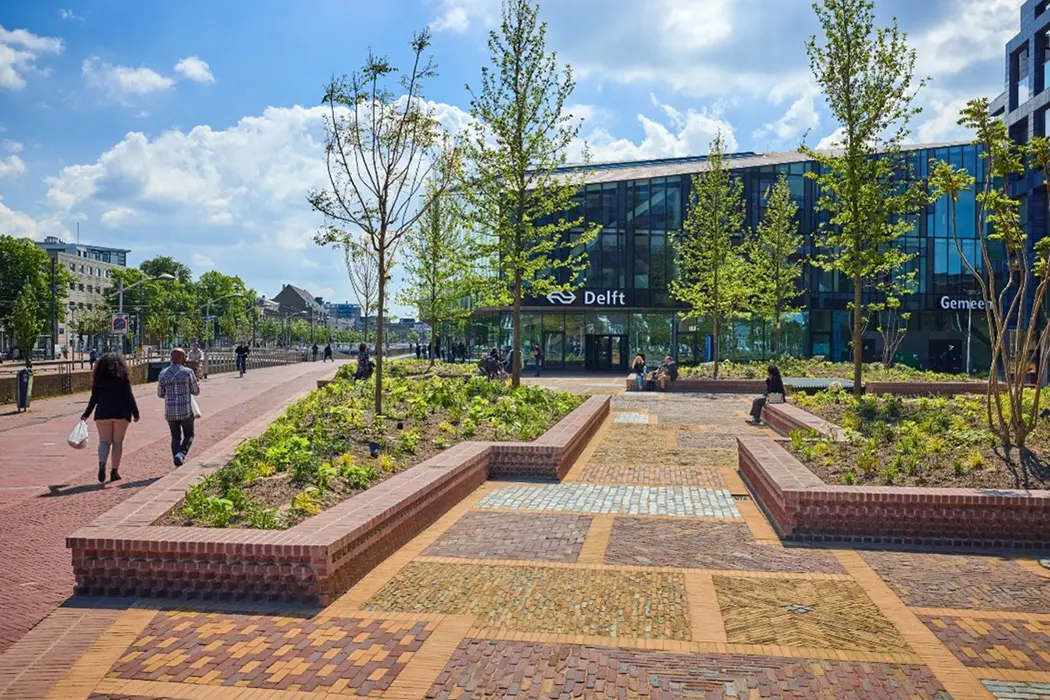
In the past, rainwater was drained as quickly as possible through our canals and ditches and later also through our (combined) sewer system. However, this is very expensive. And because the old combined sewers had a limited capacity, large showers caused frequently severe overflow of excess sewage into the surface waters. Surface water would thus become seriously polluted, its risks increasing with climate change. Further, we want to have that water at hand when it becomes very hot and dry. For nature, but also for ourselves, to cool down a bit. Hence, it is not such a good idea to drain all that rainwater as quickly as possible.
That is why the Municipality of Delft has taken many measures over the years to collect rainwater locally. For example, in 2022 the municipality determined that new buildings would no longer be connected to the clean water drainage. Rainwater must then be stored locally as much as possible. This is called water storage. Its policy rules on adaptive construction stipulate how much water must be stored per unit area. This water must also be available again to bridge a dry period of two months, so that trees and plants can survive such a period. This water storage can be found in and around new constructions in Delft, such as Park Spoorloos and the Tuin van Delft. The municipality also tries creating water storage around existing buildings, such as in the Bagijnhof. Sometimes you can combine this with vegetation. These plants and trees then also provide cooling. And if you choose the right plants and trees, many butterflies, insects and birds will be attracted to them. This policy saves money, protects water quality, cools the city and gives nature a helping hand. An overview of what has been achieved by the municipality and its residents in 2024 can be found here.
It is also possible to store water on the roofs of buildings if the roof construction is strong enough to carry the extra weight. Rooftop water storage is being considered for the new apartments being built on the Zuideinde. One refers to a polder roof, indeed a suitable name.
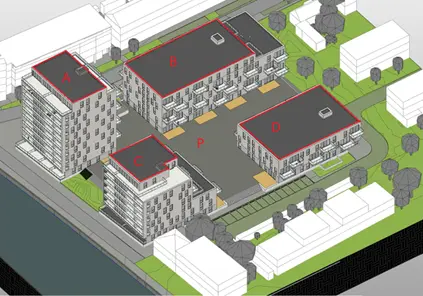
Polder roofs on residential towers on the Zuideinde.
The plants then root in a substrate, as in Park Spoorloos. The dimensions of such a polder roof are chosen so that the substrate always contains water. In this way, water is stored, the plants always have water and the temperature of the residential towers is also regulated.
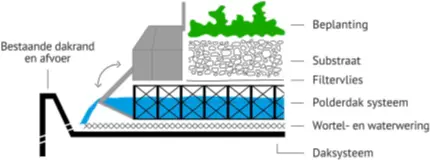
Example of a polder roof with vegetation.
Rainwater can also be absorbed into the soil by infiltration. Of course, this is only possible if the paving is permeable. That is why “lifting tiles” is so important. Even such that real Dutch tile-lifting championships are held. So where possible: replace those hard, non-permeable paving stones with flower beds. Then you will also get a more pleasant street and a more cheerful garden! The Klimaatmaat can explain to you how you can best do this.
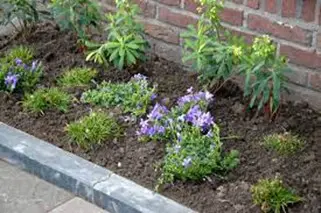
Tilting a tile – a facade garden.
And you can also replace the concrete tiles of parking spaces with grass tiles. You can still manoeuvre your car well, while rainwater can infiltrate the soil.
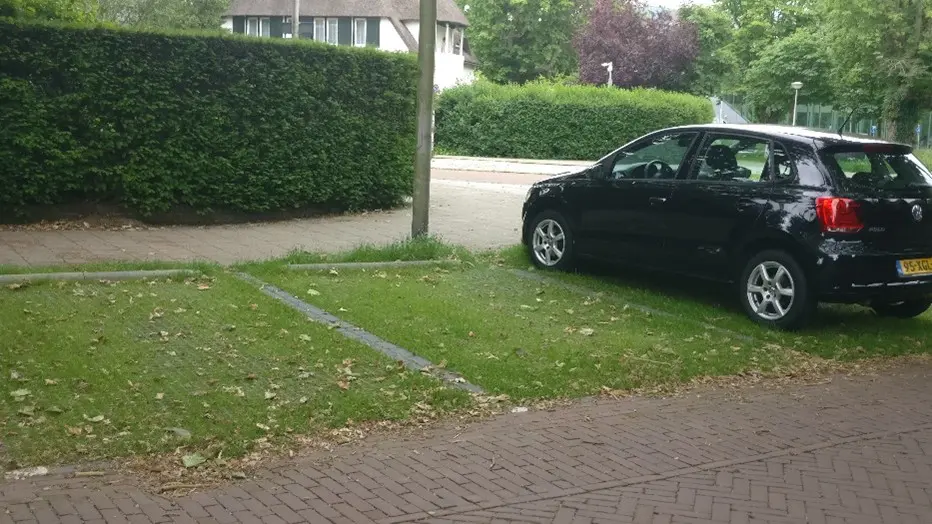
Photo of new paving on Rotterdamseweg with grass tiles.
Unfortunately, rainwater cannot infiltrate the soil equally easily everywhere. This is because the groundwater level is very high in some places. Or because the soil is very compacted by heavy traffic etc. – then the water can no longer enter the soil. Then you have to take special measures if you build a gravel bed under the street, otherwise that gravel bed will always fill up with groundwater. That is why the gravel beds in Drukkerijstraat and Laan van Braat have a waterproof foil. That makes everything a bit more expensive of course.
Outside the city areas, much more water can often be stored. The Delfland Water Board is working hard on this, for example in the Bieslandse Polder.
Read more about water storage
- Delft Municipality Disconnection Vision (2005)
- Sustainable Delft on the map (2010)
- Climate-proof Inner City Delft (2014)
- Water storage Zuideinde Delft (2020)
- Monitoring water-permeable paving in Delft (2010)
- NSD site development plan
- Dutch Tile-lifting Championships
- De Hooghe – New construction Spoorzone