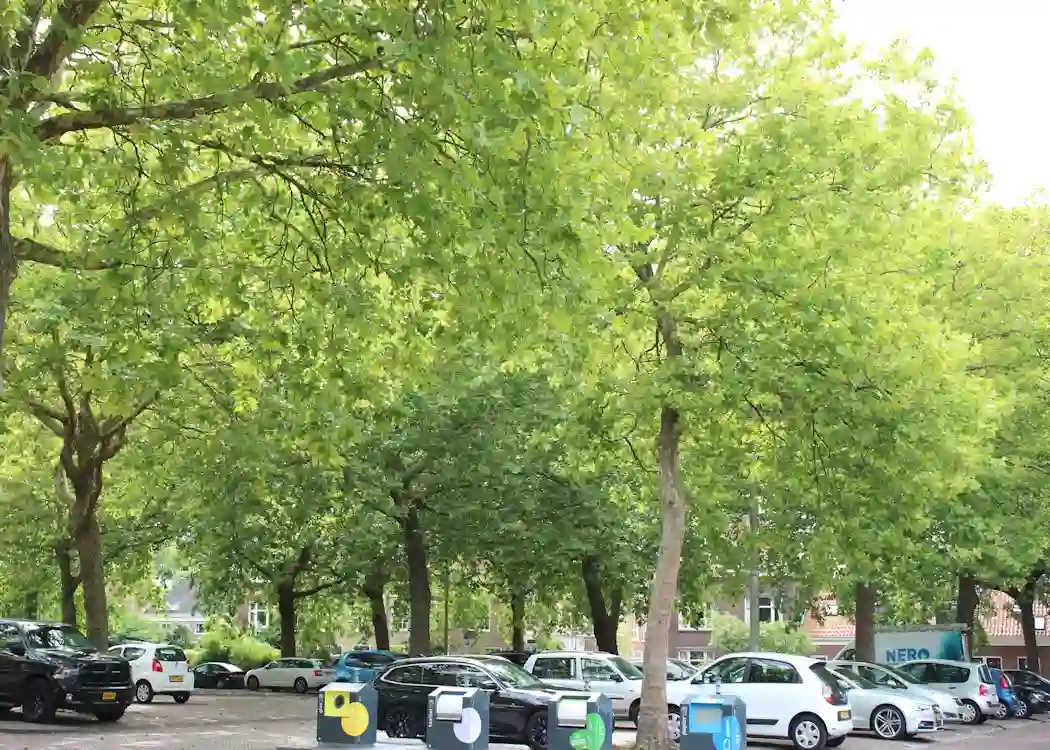
We all know that during hot weather, it is cooler in a forest/park than in the city. This is because tees give shadow. But trees also evaporate water and to evaporate water you need energy. This energy is taken from the air around the tree, which therefore cools down.
Let us take an elm as an example. It can grow to a height of 15 to 35 meters. Such trees have a leaf surface area ranging from a few hundred to many thousands of square meters (10,000 m² = 1 ha; a football field is approximately 7,000 m²). A young elm transpires about 60 liters of water per day, while a mature tree may transpire up to 170 liters of water per day (see Transpiration of Trees). This transpiration occurs throughout the day (but not at night), mainly in the afternoon when it is warm. Therefore, as an example, let us assume that e a tree that transpires 10 liters of water per hour.
You can calculate the cooling effect of a tree as follows. The specific evaporation heat of water at 25 °C is 22.6 MJ/kg (Joule is the international unit of energy, Mega = 1 million). So, to evaporate 10 liters of water per hour, you need 22.6 MJ/hr. That is about 6.000 J/s, or 6.000 Watt. For comparison, a modern refrigerator has a power consumption of a few hundred Watt.
We call this heat Q (= 6.000 Watt). It is extracted from a volume of air surrounding the elm—that volume we call V. This air therefore cools, say, by dT °C. The specific heat of air (c_air) is approximately 1000 J/kg/°C, and its specific density (rho_air) is approximately 1 kg/m³. Here is the formula to calculate how much heat is extracted from that volume V to cool the air by dT degrees Celsius:
Q = rho_air × V × c_air × dT
How large is V? A 25-meter-tall elm has a canopy of about 20 meters high with a diameter of 20 meters. That is a volume of about 4,000 m³. With some space around that canopy, we get 10,000 m³. But this naturally depends heavily on local conditions, such as wind and other nearby trees.
If we substitute all these numbers into the formula for Q, we find that this elm cools the surrounding area by almost 2 °C per hour. That is a good estimate, because measurements show that trees can cool the surrounding area by 2-5 °C. A small forest like the one at the Paardenmarkt can even exceed that.